Teaching
Book / Produced by partner of TOW
Teaching is generally held in high regard in Christian circles. Pastors who provide clear and relevant teaching from the Bible are highly valued. Sunday-school classes seek and hold on to excellent instructors. The largest proportion of small groups in churches revolve around Bible studies. One of the first steps in the discipleship of new Christians is to ensure they are grounded in “good teaching.” When new forms of church life appear, such as home churches, one of the first questions people ask about them is, What about the teaching? Many people aspire to become teachers in churches, Christian colleges or theological seminaries. In all these ways teaching comes before us as a central feature of contemporary Christian life. This is as it should be, the only difficulty being that however biblical the content of much teaching may be, there is often an unbiblical understanding of what teaching is, who should be doing it and how it ought be carried out.
What Is Teaching?
Though they overlap, teaching may be distinguished from prophecy. Prophecy is primarily a direct word of God that illuminates something in the past, present or future; this can come through any source, from a vision or dream to a parable from creation or a meditation on events. Teaching is primarily reflection on something God has already spoken or on the general revelation of God through creation and human life. The best preaching tends to be a combination of prophecy and teaching. To understand teaching better, however, we do well to turn to the biblical writings.
The role of teachers and teaching is central to the Old Testament. Important religious leaders, such as Moses, taught the people to understand the meaning of God’s covenant and law (Exodus 19:25; Exodus 31:18). Instruction was provided by the wise men in Israel (see Proverbs, Ecclesiastes), who taught in the open air, at the city gates and at crossroads, as well as at the court (2 Samuel 8:16-18; Proverbs 1:20-21; Proverbs 8:1-3). They also gathered students around them to whom they gave more regular training (Proverbs 8:32; Isaiah 8:16; Isaiah 50:4). For these wise men there was a close connection between teaching and reflective life experience. In the home, parents also had the responsibility of teaching their children the basic elements of Israel’s history and practices (Exodus 12:24-28; Deut. 6:4-9).
From all these sources it is clear that teaching was not primarily passing on what was studied in books. Learning important stories and sayings was certainly important, but this was not enough. To know something involved practicing as well as understanding what was being learned. It was a matter of the will as well as of the head. To know the truth was to have an intimate relationship with it, to become one with it and to live it out in a practical way.
In Jesus’ time there were honored scribes and rabbis who knew and taught the Law. Although he took issue with their understanding of it, and at times criticized their practice, in his day learning and teaching the Law itself continued to involve more than book learning. Students of teachers observed them, followed them around, at times resided with them. They were not just students memorizing information but disciples learning a whole way of life.
Jesus approached teaching in the same manner, but with a greater intensity. Although he is described as a prophet, Jesus is more frequently portrayed as a teacher (Matthew 8:19; Mark 10:1; John 3:32), albeit an unusual one who, unlike the scribes and the Pharisees, speaks with authority (Matthew 7:28-29). Jesus’ instruction is occasioned sometimes by events (Mark 8:14), disputes (Mark 10:41-45), challenges (Mark 2:18-22), observation (Mark 12:41-44), questions (Mark 9:11-12) and others’ comments (Mark 13). This suggests that almost anything can be the catalyst for it.
While sometimes Jesus teaches in a more structured way (Mark 6:8-11), at other times he does so less formally (Mark 9:33-37) or over a meal (Mark 14:17-21). As a teacher, Jesus gives special attention to his disciples and either explains or declares certain things only to them (Mark 4:11, 34; Mark 8:27). His followers are not presented as students engaged in formal learning of the Old Testament or merely as memorizing and passing on what he says to them. They are to learn from his actions as well as his words, and live out as well as reflect on what he teaches. As his disciples, they are to go around with him and work alongside him on behalf of the kingdom of God (Matthew 10). After his death he promises his disciples that the Holy Spirit will be with them to help them understand and implement what, by his words and life, he has taught them (John 14:15-17).
Teaching is also an important part of apostolic activity (Matthew 28:20), and in the case of Paul this takes place with colleagues who travel around with him. Paul clearly regarded himself as a teacher in the church (Acts 20:21; 1 Cor. 14:6) and values teaching extremely highly (1 Cor. 15:3; 1 Thes. 2:13; 2 Thes. 3:6). His coworkers also learn from what he has taught them (2 Tim. 3:14; compare 2 Tim. 1:12). But they learn not only from his words but from his life, from his “purpose, faith, patience, love, endurance, persecutions, sufferings” (2 Tim. 3:10-11). His colleagues are to teach others who will in turn pass on to others what they have learned (2 Tim. 2:1-2).
Elsewhere in the New Testament we come across attacks against false teachers, who are more concerned with advertising themselves and deceiving or controlling their hearers than with passing on the message of God (2 Cor. 11:19-21; 2 Peter 2:1). They have the capacity to influence whole churches in unhelpful directions and must be strongly resisted (Rev. 2:20-25). In the letter of James we also find warnings against wanting to become a teacher without considering how large a responsibility it is, how much teachers will be held accountable for what they say and do, and how closely understanding is connected to character and behavior (James 3). We also find reference to how learners should be passing from an elementary stage in understanding and living out their faith to a more advanced level of knowledge and behavior (1 Cor. 3:1-3; 1 Cor. 14:20-21; Hebrews 5:11-14).
Teaching, then, is a far broader undertaking than we tend to think. As Parker J. Palmer (p. 31-32) says, we understand it better if we relate it to the original meaning of truth that is still preserved in the old word troth in some wedding services. Knowing is more than gaining insight into the truth of something: it involves being betrothed to it so that it captivates us, our lives revolve around it and we serve it in very practical ways. So too in teaching we seek to bring others not just to an understanding but to an intimate love of the truth, so that they pledge themselves to it and devote themselves to its service. To succeed in this we need, as Palmer also puts it, to teach in such a way that we “create a space in which obedience to truth is practiced” (p. 69). The good teacher opens up a hospitable space in which new ideas can receive a welcome, people’s feelings and hesitations be acknowledged, discussion take place and friendship between teacher and learner be established.
Who Are the Teachers?
It is clear from the New Testament that some people have a special gift of teaching and others do not, and that this gift comes from the Holy Spirit. As Paul says, not all people are teachers (1 Cor. 12:28). Most people have drawn the conclusion from this that teachers require formal qualifications before they can exercise their talent and that only a few Christians can ever be involved in instructing others. Both conclusions are far from the truth. In the first place, Jesus frequently criticized the Pharisees though they had professional training in understanding the Law and divine authority to expound it, not only because their practice did not match their teaching but also because their teaching leads people astray (Matthew 15:3-9; Matthew 23:1-4).
In the second place, already in the Old Testament the prophets looked forward to the time when, as God promised the people, “I will put my law in their minds and write it on their hearts. . . . No longer will a man teach his neighbor, or a man his brother, saying, `Know the Lord,’ because they will all know me, from the least of them to the greatest” (Jeremiah 31:33-34). In line with prophetic revelation, the gift of the Spirit at Pentecost (Acts 2:17-18) falls on all people, young and old, women and men, servants and masters, so enabling the word of Christ to “dwell richly” in all, equipping them all to “teach and admonish one another” in the church (Col. 3:16). Although those who have a special gift along these lines should bring “a teaching” to the church when it gathers (1 Cor. 14:26), it is also open to any member to share their understanding of God with others in the meeting when it is appropriate to do so.
So alongside, or included within, the “priesthood of all believers” is a “teacherhood” of all believers. It is because God shares the truth about the divine character and purposes among the people of God rather than to just a few people within them that the whole truth about God takes place only as all members of a church are playing their individual part in building up one another’s understanding. Since it is difficult to make room for this in larger gatherings of the congregation, it is especially in small groups and house churches (see Church in the Home) that such mutual instruction most effectively takes place. It is particularly in such settings—as members bring to the group situations, challenges, problems they are facing, and as members open the Scriptures, share their insights into them, and wrestle together to understand the will of God—that God builds up their understanding and directs their behavior. Such teaching and learning are always prepared to be augmented by whatever other understanding God may give through the practice of other spiritual disciplines and the exercise of spiritual gifts in the group.
Within such smaller groups and larger gatherings of the congregation there is a special place for those who have the ministry of teaching to a greater degree. Every group and congregation should be on the lookout for such people and encourage them to develop and refine their God-given ability. It is not formal theological education alone that qualifies such people to teach, though anyone who has a gift of teaching would only benefit from undergoing this. What primarily qualifies people to teach is long-term dwelling in the Scriptures—reading, pondering, praying and applying them—so that they begin to know them from the inside and see connections between the diverse materials contained within them. What also qualifies them, as Luther said long ago, is experience of life itself, especially suffering. Through this they come to see and embody ever-deepening connections between Scriptures and everyday living. So it is people who come to know the mind, heart, imagination and will of God, who discern what this means for themselves, those around them and their wider world, and who live out what they have learned who are best equipped to provide the fundamental instruction in the church. Such people have a particular opportunity to share what God is teaching them when the whole congregation comes together. As in some earlier church traditions, for example, among the first Anabaptists, this could take the form of two or three spokespeople sharing with the congregation.
How Does Teaching Take Place?
Although something has already been said about Jesus’ practice here, on this point Paul is once again a helpful guide. For him, though teaching sometimes included passing on a fresh understanding of God’s written revelation in the Old Testament (for example, Romans 9-11), it goes far beyond that. He draws on what he observed about him in everyday settings (Acts 17:16-23), from his own experience of God and life (2 Cor. 4:7-18), from the statements or writings of non-Christian writers (Acts 17:28; 1 Cor. 15:33), and from some of the customs and conventions of his time (1 Cor. 11:14). It is passed on in a range of settings, from formal lecture rooms at the regular scheduled times to conversation in the early hours of the morning in a home (Acts 19:8-9; Acts 20:11). As a teacher he was more concerned with whether others were learning what he was saying, drawing proper conclusions from it and putting it into practice (Romans 6; Romans 7:7-25; Romans 15) than with instructing them in fancy and eloquent ways based on human performance rather than Holy Spirit depth (1 Cor. 2:1-4).
Paul’s teaching also took many forms, such as personal reminiscences (Galatians 2:1-10) and testimony (Romans 11:33-36), discussion of struggles and humiliations (2 Cor. 11:16-33), and advice on a wide range of matters from relating to God to various aspects of daily life (1 Cor. 6-10). It took the form of asking questions as well as making statements, of giving praise as well as giving instruction, of speaking from the heart as well as from the head. It sought to argue and persuade rather than dogmatize and decree. And as the greetings on most of his letters indicate, instead of being only a solo effort, much of his teaching was a collaborative affair involving his coworkers as well.
All too often teaching is identified with one person standing up with the Bible or notes in front of them holding forth at length to an audience or group, perhaps with some time for questions and answers afterward. But there are a diverse range of ways in which teaching can take place. It can, and occasionally should in very large groups, occur in the form just mentioned. But most commonly it should take a more dialogical or conversational character. When Paul was speaking in the church at Troas we read that he “dialogued” with them (Acts 20:7) and then “conversed” with them during and after their common meal (Acts 20:11). This, as some translations bring out, is the force of the Greek words in these passages. In other words, during the early part of the meeting he had things to say but opened up opportunity for a serious discussion of these with the people whom he was addressing. In the later part of their meeting there was leisurely room to talk more informally about a whole range of issues connected with the Christian life. Paul’s letters often betray his speaking practice, for they are full of questions that he imagines people asking or that he asks to an imaginary audience. He quotes from what they might have said if present or detours to clarify points where he suspects they will misunderstand. In all this Paul provides a good model for those engaged in teaching, especially in larger gatherings.
In smaller gatherings of the church there are many other ways of teaching. Teaching may take the form, as it so often did with Jesus, of sharing a parable or riddle for people to reflect on at length and in practical ways; it may take place through asking a profound question or stating a provocative thesis that forces people to explore some doctrine or issue in a way they have never done before; it could involve telling a personal or secondhand story about some formative experience so that others are stimulated to progress in their own spiritual or vocational journey; it might entail, as it did at times for the prophets, acting something out or getting the group to act out a story, so that learning takes place through seeing as well as hearing; it might mean, as sometimes happens among the wise in the Old Testament, composing an instructive song or poem, whose meaning the group then weighs and applies; or it could occur by leading people through a meditation on a particular passage or through an exercise in guided contemplation on some experience, followed by some sharing of their findings.
Broadening our understanding of how teaching takes place also broadens our appreciation of who can engage in it. Though not everyone has the gift of more directive instruction, many have abilities that would allow them to teach in one or more of the ways outlined. In all settings where teaching takes place—whether small or large, informal or formal, spontaneous or organized—it is important that those who receive it ask for discernment as to its truth and, when necessary, call upon those who have a special gift in this direction (1 Cor. 12:10). This again demonstrates that teaching is not a solo activity but one requiring the involvement of others to have its full and proper effect. It only remains to add that those who are teachers remember that, strictly speaking, they, along with everyone else in the church, are only students themselves, for as Jesus said, “You are not to be called rabbi, for you have one teacher, and you are all brethren” (Matthew 23:8 RSV).
» See also: Christian Education
» See also: Education
» See also: Laity
» See also: Ministry
» See also: Preaching
References and Resources
J. A. Grassi, The Teacher in the Primitive Church and the Teacher Today (Santa Clara, Calif.: University of Santa Clara, 1986); R. K. Greenleaf, Teacher as Servant: A Parable (New York: Paulist, 1979); H. Nouwen, Creative Ministry (New York: Doubleday, 1978); P. J. Palmer, To Know As We Are Known: A Spirituality of Education (San Francisco: Harper & Row, 1983).
—Robert Banks





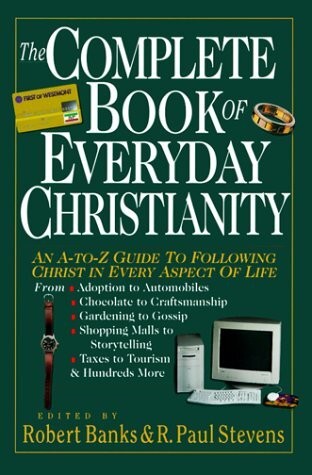
The authors Robert Banks and R. Paul Stevens have partnered with The Theology of Work Project to offer The Complete Book of Everyday Christianity in its entirety here. All rights reserved.
This resource was originally published in 1997, and the text has not been updated.