Taxes
Book / Produced by partner of TOW
If the only two things of which we can be sure are death and taxes, we might want to spend as much time and thought thinking about the latter as we do the former! Yet, while the Old Testament contains some references to the payment of tributes and Christ talks a little about appropriate attitudes to tax reform, it is very difficult to find modern writers who help us develop a deeper understanding of discussions about taxation. Engaging in thoughtful dialogue is made still more challenging because, despite the pervasiveness of taxation in everyday life, no area of public policy is more veiled from public understanding. The debate is focused on two issues: paying taxes and spending tax revenue.
Paying Taxes and Spending Tax Revenue
People resent paying taxes they perceive as unfair. In the literature of public finance, tax fairness has a very specific meaning, referring to the distribution of the burden of taxes among individuals. For the public, tax fairness is a multidimensional concept reflected in different ways in the tax system and in discussions of tax policy. Tax fairness encompasses the nature of what is taxed—property, sales, income or profit—overall levels of taxes, the individual’s ability to pay, the question of exempting some from paying for reasons other than ability to pay (such as religious freedom or encouraging job creation) and the relative amounts of the tax burden we share with our neighbors.
People also raise questions of fairness when they see money raised from taxes being spent in ways with which they disagree. Our differences can be deeply philosophical, such as whether or not people should pay taxes when government intends to use the money for the purchase or use of arms. Others question whether those who do not benefit from a service such as education should be forced to pay for it. Still others ask if those (such as cigarette smokers) whose behavior means that they are more likely to require the use of a costly service (such as health care) should be required to pay for that service to allow those who alter their behavior (by refraining from smoking) to pay less. Others advocate the imposition of special taxes (such as green taxes) to be earmarked to resolve special problems (such as environmental degradation).
These questions become more and more pertinent as times get tougher. When paychecks are shrinking, people are much more conscious of the amount that comes off the top in taxes and more concerned about how that money is spent by governments. At the same time, decision-makers perceive that they face constantly increasing needs for services. The so-called experts in this field are often unable to talk about the issues without resorting to jargon. The vast majority of us who are trying to understand how best to balance issues of our own well-being and conscience with the real needs of others for support find we are unable to effectively participate in the debate unless we resort to oversimplification and add to the existing polarization. Tempers flare. Laws are passed in the heat of the moment, which create problems later. Communities are divided. People go without services they need because of perceived abuses by others.
What are appropriate answers to the issues surrounding taxes? What questions could we be asking to provide helpful leadership in this often divisive and sometimes destructive debate? Are there any “right” answers? What lessons was Christ trying to teach when he taught on the subject? Does the Old Testament provide any guidelines for contemporary policy?
Old Testament Perspectives
When Joseph began his rule over Egypt, he wisely set aside food from the years that yielded good crops for the famine years that followed. There is still a broad public consensus that the common good is served by setting aside provisions for a rainy day. But, as in biblical times, the consensus breaks down when people do not agree on the amount, the uses to which is it put and the degree to which they are consulted. One of the important factors that allowed Moses to persuade the Jews that they should leave Egypt was their resentment over taxation. When Bostonians expressed their resentment about taxation without representation by throwing boxes of tea into the harbor and declaring their independence from England, they were following in an age-old tradition (Genesis 41:34; Exodus 1:11; Deut. 14:22-27)!
The Old Testament endorses rulers collecting taxes to prevent uprisings by providing services and anticipating future needs. Its stories also remind us that when rulers do not provide satisfactory explanations for taxation or fail to redistribute tax revenue in ways that are perceived to be fair, people will object, sometimes at great cost to both parties. It seems a lesson that the Judeo-Christian world is destined to learn over and over again (Genesis 49:15; Neh. 5:1-5).
Another theme is people signifying their subjection to a ruler through the payment of taxes or conversely signifying their independence by refusing to pay (Deut. 18:1-5; 2 Samuel 8:6; Ezra 4:13; see Civil Disobedience). These stories and teachings formed the foundation of thinking about taxation for those who encountered Jesus and his followers.
The Gospels
There are two passages in which Jesus focuses on taxes. The first concerns the Pharisees’ query about paying taxes to Caesar (Matthew 22:17-22). Some argue that this is a firm instruction to pay taxes no matter how distasteful. At first glance it could be taken to be such a statement, especially when it is combined with the following excerpt from Paul’s statement about paying taxes in his letter to the Romans: “That is also why you pay taxes, because the authorities are working for God when they fulfil their duties. Pay, then, what you owe them; pay them your personal and property taxes, and show respect and honor for them all” (Romans 13:6-7 TEV). In Christ’s time Jews hated paying taxes to the Romans for many reasons. They disliked paying in Roman coin because it meant they had to trade in the oppressor’s currency in order to have the money to pay. They hated the symbolism of being forced to pay for the economic and military might that kept them subjugated. They resented that they did not have complete autonomy over their own communities. Their religious leaders taught that the empire was immoral and ungodly. Tax collectors were reviled as collaborators with the enemy. Income and other state taxes combined with religious and community taxes were heavy—about 40 percent of their income. In this context, these teachings seem firm indeed!
But might there not be other interpretations? Is it conceivable that Jesus was teaching the importance of strategic thinking? Might he be arguing that taxation is not symbolic of anything unless we choose to make it so? In the past much trouble had been caused by those who confused the payment of taxes with moral or spiritual obeisance. Perhaps Jesus reminds us that we can allow government to take our tax payments without giving it any authority over the realm that must be governed by our relationship with God. To refuse to pay taxes in his time would have been seen as sedition. Paul might have been reminding us of the importance Christ placed on picking our battles wisely.
The second passage (Matthew 17:24-26) concerns the official query about paying the temple tax. This also speaks of strategy. Jesus is reminding us that we can make the payment of taxes into an issue or not as we choose. Whenever we have discerned real choices, God will provide the resources with which to carry them out. “Ask and it will be given to you” (Matthew 7:7) applies to this instance as well.
If we accept that we do have a choice about whether to pay taxes, what principles should guide us as Christians in modern debates about tax policy? Jesus taught us several lessons here. He did not confront Peter in front of the tax collectors but waited until they were alone. He began with a quiet, affirming question—one to which he knew Peter would know the answer. His question assumed the right of common people to engage in discussion about tax policy and their capacity to do so thoughtfully. Finally, he asked Peter to find the resources to pay the tax without hardship and by doing what he did best—fishing.
We would do well to engage in debates about taxation respectfully, in community with others and with reference to resources for paying it stemming from the work they are called to do. We also learn the importance of not leaving this issue of public policy to the experts but rather owning it as our rightful domain. Because the question of fairness is so subjective, Christians and other morally concerned people have an important role to play.
When the payment of taxes threatens to cause hardship, we might well remember the lessons of the Old Testament and ask if the debate might become less heated in an atmosphere of real consultation. But hardship is relative. When we hear wealthy people stating their reluctance to encroach upon their children’s inheritance so that they can remain in their large houses and pay property taxes, we might also remember Jesus’ teachings about becoming anxious over money (Matthew 6:19-20, 24-34) and about the difficulty rich people have in reaching a state of grace (Matthew 19:23-24). When we hear people saying, “There is no such thing as a fair tax,” we might ask a gentle question about what services they would like to see disappear first. When basic goods and services are taxed, we might remember that Jesus was a carpenter and that Christians are especially called to listen to the voices of all people in the discussion, including those of the poor and lowly. Indeed paying taxes is one way of exercising neighbor love and of exercising personal partial impoverishment for the sake of less fortunate citizens (see Poverty; Wealth).
Conclusions
When the Pharisees asked Jesus about the greatest commandment, he answered: “'Love the Lord your God with all your heart, with all your soul, and with all your mind.’ This is the greatest and most important commandment. The second most important commandment is like it: `Love your neighbor as you love yourself.’ The whole Law of Moses and the teachings of the prophets depend on these two commandments” (Matthew 22:37-40 TEV). To the extent that paying taxes has to do with neighborliness, we are called to address the issue of tax fairness in the context of our obligations to, and relationships with, God and people. In this regard we must ask what use is made of the taxes we pay. In a modern economy we delegate looking after our neighbors as we would be looked after ourselves. As Christians we know that God will feed, clothe, educate and heal us in the way we do this for our neighbors. We know that when we do it for one of God’s smallest creatures, we do it for God. Taxes are the main method we have of transferring revenue from those who have to those who are in need.
But what if there is disagreement about the value of the chosen system of redistribution? What principles might we look to if we think that the welfare state encourages permanent and damaging dependency or that we do not love our neighbors if we allow our tax dollars to be used to purchase and employ weapons?
As in so many things, there are no easy answers. But if we allow ourselves to be guided by the two great commandments and leave the judgment of others to the Lord, there is some hope that we may influence the dialogue around us respectfully and critically as we struggle to arrive at meaningful answers.
» See also: Politics
» See also: Principalities and Powers
» See also: Wealth
» See also: Will, Last
References and Resources
Ontario Government’s Fair Tax Commission, Fair Taxation in a Changing World (Toronto: University of Toronto Press, 1993).
—Patricia Lane





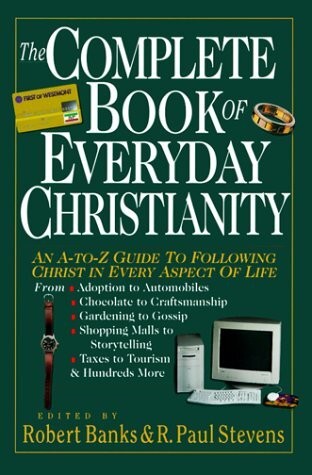
The authors Robert Banks and R. Paul Stevens have partnered with The Theology of Work Project to offer The Complete Book of Everyday Christianity in its entirety here. All rights reserved.
This resource was originally published in 1997, and the text has not been updated.